
How to prevent material clumping during pneumatic conveying process?
? ? The ability of pneumatic conveying systems to control particle formation, whether in cultivating it or preventing it, is crucial for handling bulk solidsThe basic skills of mixed operators.
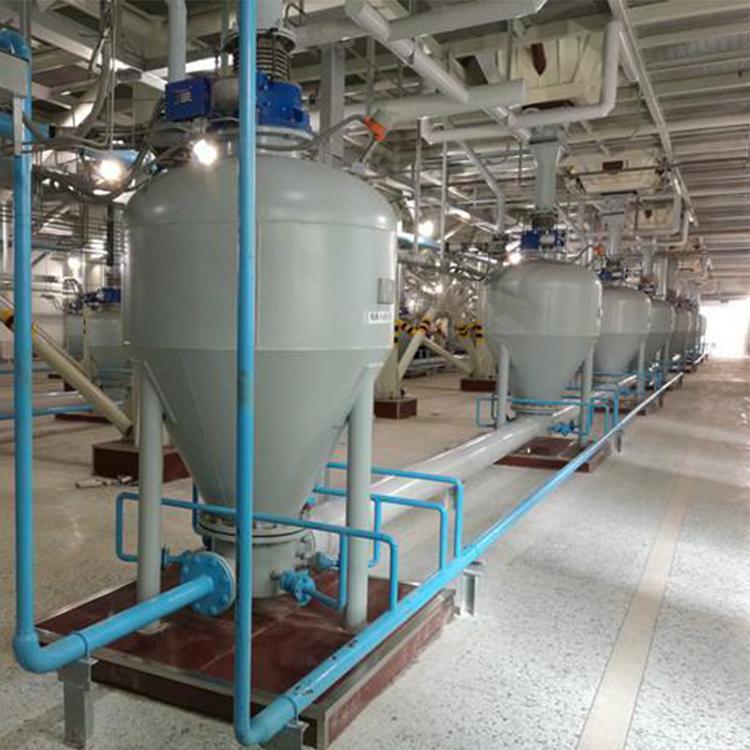
? ? Pneumatic conveying systems serve the main processing materials in various industries, preparing materials for subsequent processing and ensuring product qualityQuantity to meet production needs. The property of combining pneumatic conveying systems with automatic batching systems is that, in addition to mixing, they can also promoteAgglomeration and expansion of particle size can bring many benefits to powdered bulk solids, including improved transportation and handlingFeatures, improved performance, etc.
? ? However, when it comes to automatic batching, clumping is not always desirable - many industrial process settings and products requireThe material exists in the form of small or very small particles. Regardless of whether the clumping is ideal or not, pneumatic conveying system operatorsThey often struggle to prevent clumping or promote clumping during the mixing process, in order to achieve the desired particle size or quality.?
? ? Many pneumatic conveying system operators see this challenge as inevitable and fail to realize that their processes can be challengingTo run better through some adjustments. Therefore, the ability to manipulate and control particle formation, whether promoting it or inhibiting itStopping it is a fundamental skill for mixed operators in the field of bulk solid handling.
? ? When agglomeration occurs unintentionally, downstream processing equipment of the pneumatic conveying system may not be able to handle the material correctly. dryDrying machines with fine particles or small clumps may not be able to fully dry larger clumps, which may require further processing, or,If not captured, the product may clump or spoil during storage or transportation.
? ? Similarly, the material that should be pelletized but is unlikely to be blown out of the dryer through the exhaust system of the pneumatic conveying system, becauseThe air velocity of the dryer is designed for particles rather than fine powder.
? ? In any of the above situations, the result is usually product loss or deterioration, increased processing costs, and delayed production timeLong term, reduced efficiency, decreased productivity, poor product quality, ineffective downstream processing, and many other possible issuesQuestion.
? ? By providing the knowledge and tools required for mixed operators to control clumping, these issues can be minimized, typicallyIt can be completely avoided.
? ? Contrary to common belief, the formation of particles is not the result of a specific device, but rather the material's behavior at a specific timeThe result of how characteristics and environment function. When agglomeration occurs in the mixing container of a pneumatic conveying system, particle formation isA result of non pressure agglomeration called stirring agglomeration, also known as wet granulation, granulation, or rolling growth agglomeration.
? ? Blenders are a major example of mixing that can occur anywhere, as they often mix liquids through agitationMix with dry solids. In fact, under appropriate conditions, any pneumatic conveying system mixer can complete itMixing process.
? ? In order to control material mixing during the mixing process, pneumatic conveying system operators must recognize and understand thisThe principles behind various types of lumps.
? ? As the most important factor affecting the formation of lumps, the following pneumatic conveying system parameters can be controlled during the processingTo enhance or prevent agglomeration in industrial mixing systems. Some of these factors can be adjusted in real-time, while othersMore extensive adjustments are needed, such as changes in suppliers or modifications to processes.
moisture content
? ? Moisture content is a key influencing factor in promoting and preventing clumping. Does any moisture exist during this processRaw materials are added through the use of liquid adhesives or from the environment.
? ? The general rule of thumb is that the higher the humidity, the more likely it is for clumping to occur, although this is only partially correctof If too much water is added, the material will turn into a mud like state and cannot clump properly.
? ? Therefore, operators of pneumatic conveying systems can manage clumping by closely monitoring the water content during the process. ifThere have been undesirable clumps, and they must take measures to reduce moisture, such as lowering the moisture content of the raw materials or reducing the liquid contentThe amount of adhesive added to the body. Adjusting the amount of adhesive used is not always feasible as it may affect the product's compatibilityTherefore, depending on the product, this method may or may not be an option.
? ? Another option to reduce moisture content may be to use a technique called reverse mixingMix the dried raw materials to reduce the overall moisture content. Dispersants can sometimes be used to prevent the formation of lumps in a mixtureBody.
? ? Similarly, when promoting agglomeration or attempting to accelerate agglomeration growth, operators can take measures to increase water during the processDivide.
? ? However, it is important to note that the influencing factors described here (including moisture content) do not act aloneThe occurrence or lack of aggregation is often the result of several interrelated factors. For example, in addition to humidity, in order to provideIt can also test other factors, including spray rate, position and even sprayMouth type.